

Precision Components Without the Hidden Cost
How Controlled Processes and Early Validation Protect Automotive and Medical Programs
Automotive and medical manufacturing teams don’t have the luxury of trial and error. Programs are complex. Precision components operate at tight tolerances, timelines are unforgiving, and once tooling is cut, mistakes become expensive very quickly.
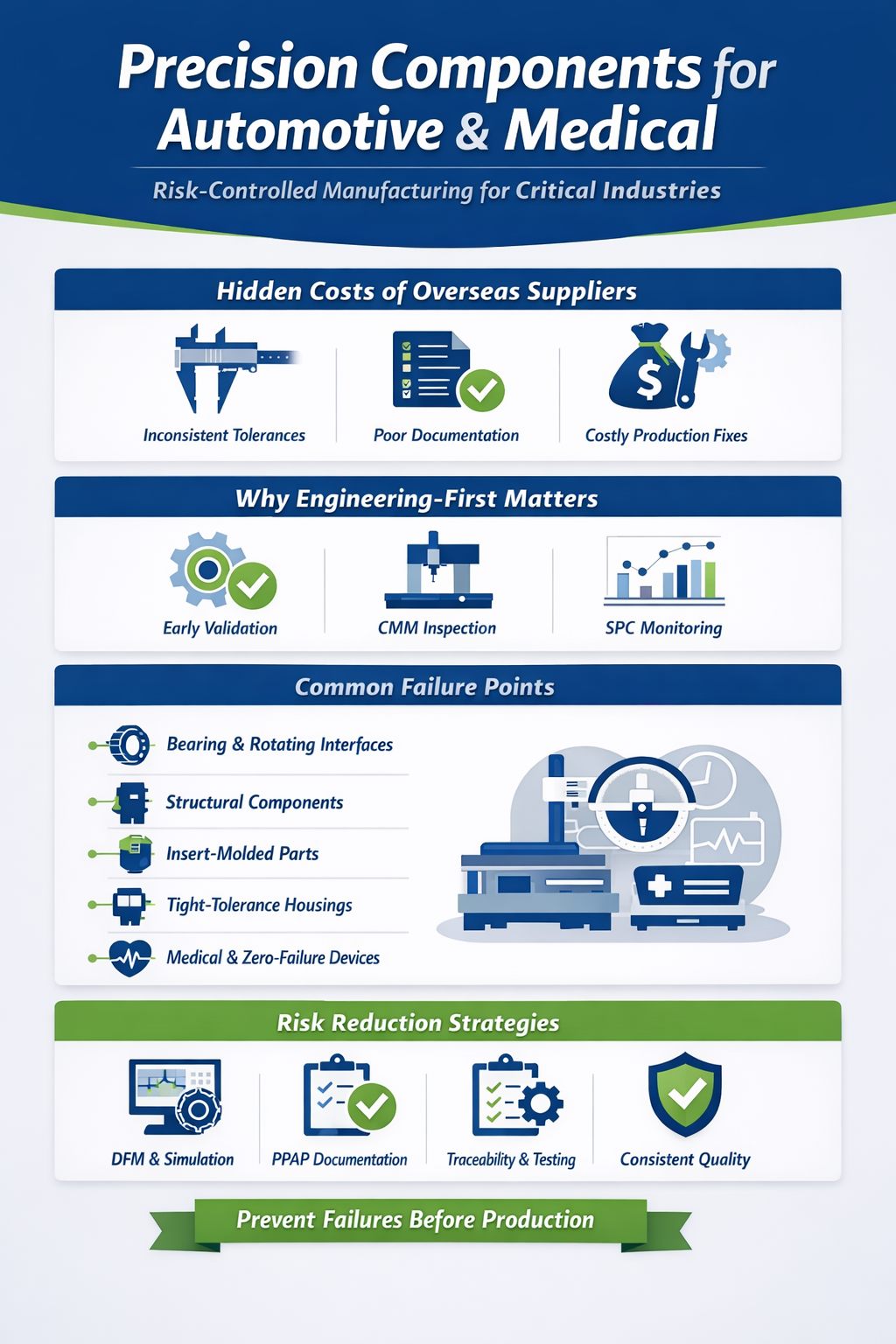
Many overseas suppliers promise a low piece price. What they rarely guarantee is dimensional stability over time, PPAP-ready documentation, and predictable outcomes across production runs. In fact, the hidden risks of overseas precision component sourcing often surface only after production begins, when changes are hardest to fix.
This guide explains how precision component failures occur, why buyers often keep paying for them long after RFQs are signed, and how engineering-first precision component manufacturing helps automotive and medical teams reduce risk before it reaches production.
Precision Components Are Not “Parts” — They Are Risk Zones
In regulated and performance-critical industries, precision components are not commodities. They are the interfaces where failure appears first, including:
- assemblies that don’t fit
- bearing interfaces that wear prematurely
- housings that warp after validation
- inserts that shift under load
- parts that pass T1 and fail months later
ACE Mold operates upstream in the supply chain, manufacturing custom precision components to customer drawings, tolerances, and validation requirements. These components are then integrated into larger systems by OEMs and Tier-1 and Tier-2 suppliers.
Below are six precision component application categories where buyers most often lose money, and how those risks are prevented.
1. Bearing Housings & Rotating Component Interfaces
The Pain Buyers Face
Bearing housings often look simple on drawings, but they are unforgiving in real-world use. Even small deviations can lead to:
- noise and vibration issues
- premature bearing wear
- heat build-up under load
- inconsistent rotation or seizure
Many buyers only discover these issues during endurance testing or early field use.
The Risk Behind the Problem
Bearing-related precision components are highly sensitive to roundness, concentricity, tolerance stack-up, thermal expansion, and long-run dimensional drift. Without early validation and simulation before tooling starts, these risks remain invisible until production.
How It Costs You
- repeated PPAP submissions
- re-machining or re-tooling
- warranty exposure
- escalations from OEM quality teams
How These Risks Are Controlled Before Tooling
ACE Mold treats bearing housings as precision interfaces, not molded shapes. This includes:
- DFM and tolerance stack-up review before tooling
- Moldflow and shrinkage analysis to control ovality and warpage
- CMM validation for roundness and GD&T features
- SPC monitoring to maintain long-term stability
The result is predictable fit, controlled wear behavior, and lower lifecycle cost.
2. Electroplated Circular Bases & Load-Bearing Structural Components
The Pain Buyers Face
Structural precision components often fail quietly. Parts may pass first article but deform under sustained load, temperature cycling, or assembly stress. Failures typically appear later as misalignment, rocking, or downstream assembly problems.
The Risk Behind the Problem
Key risks include uneven material flow, poor cooling design, unvalidated wall thickness, and lack of stress simulation. Without early validation through simulation, deformation becomes locked into the tool and expensive to correct later.
How It Costs You
- assembly rework
- tooling modifications after T1
- delayed SOP
- added engineering hours
How Engineering-Led Validation Prevents This Failure
ACE Mold focuses on structural predictability, not cosmetic acceptance. Their approach includes early simulation to analyze stress and deformation, optimized cooling and gate placement, material behavior validation before steel is cut, and controlled trial data reviewed for repeatability.
This ensures the part behaves correctly in real operating conditions, not just on inspection reports.
3. Insert-Molded Precision Components
The Pain Buyers Face
Insert-molded precision components are among the most expensive failures to fix. Common issues include:
- insert movement during molding
- poor bonding
- micro-misalignment
- stress cracking around inserts
These problems often appear late in validation or during assembly.
The Risk Behind the Problem
Insert molding requires precise insert positioning, stable process windows, and repeatable clamping and flow behavior. Low-tier suppliers often treat insert molding as standard injection molding, without additional validation.
How It Costs You
- scrapped assemblies
- repeated mold trials
- quality holds
- missed regulatory or SOP milestones
How Process Control Protects Long-Run Stability
ACE Mold designs insert-molded precision components with failure prevention in mind, including insert retention and alignment analysis during DFM, controlled mold design to prevent shift, trial sampling focused on repeatability rather than appearance, and documented process settings to maintain stability.
This protects both assembly integrity and downstream validation timelines.
4. Sensor, Connector & Tight-Tolerance Plastic Housings
The Pain Buyers Face
Sensor and connector housings demand extreme consistency. Small deviations can cause poor sealing, connector fit issues, electrical failures, and assembly line rejects, which are especially costly in EV and safety-related systems.
The Risk Behind the Problem
This category is vulnerable to tolerance drift over long runs, inconsistent cooling, and uncontrolled parameter changes. Manual inspection alone cannot detect early drift.
How It Costs You
- high reject rates
- line disruption
- emergency containment actions
- supplier scorecard damage
How Early Validation Reduces Downstream Cost
ACE Mold prioritizes process stability through scientific molding with DOE-based process windows, SPC tracking for critical dimensions, CMM validation instead of caliper checks, and disciplined change control during production.
This reduces batch-to-batch variation and protects assembly yield.
5. Medical & Automotive Device Housings (Zero-Failure Components)
The Pain Buyers Face
In medical and regulated automotive programs, failure is not negotiable. Even minor issues can invalidate test data, delay regulatory submissions, or force costly redesigns.
These precision components demand full traceability, documented validation, and repeatable accuracy across runs. This is especially critical for medical startups and regulated programs operating under zero-failure expectations.
The Risk Behind the Problem
Medical and safety-critical automotive housings demand:
- full material and process traceability
- documented validation at each stage
- repeatable accuracy across production runs
Suppliers without strong documentation discipline introduce compliance risk that often surfaces during audits, not during early samples.
How It Costs You
- delayed approvals
- lost development momentum
- audit findings
- program credibility damage
How ACE Mold Ensures Zero-Failure Program Readiness
ACE Mold supports zero-failure expectations through early validation samples, documented DFM and simulation records, material and process traceability, and repeatable manufacturing backed by inspection data.
This gives teams confidence not only in the part, but in audit readiness.
6. Precision Pins & Alignment-Critical Components
The Pain Buyers Face
Precision pins are small, inexpensive components on a BOM, but they often control alignment, positioning, and load transfer inside larger assemblies.
When pins are even slightly out of specification, buyers encounter:
- assemblies that bind or seize during operation
- uneven load distribution leading to accelerated wear
- misalignment between mating components
- inconsistent fit during final assembly
These problems are rarely obvious during first samples and often surface only during endurance testing, system integration, or early field use.
The Risk Behind the Problem
Precision pins are highly sensitive to:
- straightness and concentricity
- diameter consistency over length
- surface finish and coating thickness
- thermal effects and long-run tool wear
Many suppliers treat pins as simple turned parts, relying on basic inspection and short-run validation. What is often missing is verification of repeatability, post-processing effects, and dimensional stability across production volumes.
Because pins frequently interface with multiple components, even small deviations can propagate alignment errors throughout an assembly.
How It Costs You
When precision pins fall outside controlled limits, the impact multiplies quickly:
- assembly rejects and rework
- repeated inspection and sorting
- delayed validation or SOP milestones
- escalations from quality and integration teams
In regulated automotive and medical programs, these failures consume engineering time, delay approvals, and increase total cost of ownership far beyond the pin’s unit price.
Ensuring Alignment Accuracy in Precision Pin Applications
ACE Mold treats precision pins as alignment-critical components, not generic hardware.
Their approach includes controlled machining with tight process windows, validation of straightness, concentricity, and surface finish, CMM-based inspection for critical dimensions, and monitoring of tool wear and dimensional drift over production runs.
By validating both geometry and repeatability, ACE Mold ensures precision pins perform consistently inside real assemblies, protecting downstream integration, validation, and long-term reliability.
What “Good” Looks Like in a Precision Component Partner
Across all six categories, reliable precision component suppliers share common traits:
- engineering involvement before tooling
- early validation through simulation and sampling
- CMM-based inspection and SPC
- PPAP-ready documentation
- stable, repeatable processes
- transparent communication
This is not about perfection. It is about control.
Why ACE Mold Fits This Role
ACE Mold is a B2B precision component manufacturing partner, not a reseller or catalog supplier.
Operating since 2006, ACE Mold supports automotive and medical programs with engineering-first tooling development, validated precision manufacturing, documented quality systems, and predictable delivery timelines.
Their focus is simple: prevent failures before they reach your program.
A Practical Closing Thought
Most buyers don’t lose money because they chose an overseas supplier.
They lose money because the supplier failed to identify risk early, control precision over time, and document what matters when it counts.
If your program requires precision components that hold up beyond first samples and documentation that stands up in audits, working with an engineering-driven partner makes the difference.
If you’re looking for a PPAP-ready, documentation-strong precision component supplier, ACE Mold supports teams who need predictability, not promises.
Common Questions Automotive & Medical Teams Ask About Precision Components
Where do precision component failures typically originate in automotive and medical programs?
Answer:
Most precision component failures originate upstream, before tooling is finalized. Common root causes include incomplete DFM, missing simulation, unvalidated tolerance stack-up, and lack of process stability planning. These issues often remain hidden until production or regulatory validation, when correction becomes costly.
Why do precision components pass first samples but fail during production runs?
Answer:
First samples often reflect short-term capability, not long-term stability. Failures during production runs are usually caused by dimensional drift, thermal effects, inconsistent cooling, or uncontrolled process parameters that were not validated during early sampling.
How does early validation reduce total cost of ownership for precision components?
Answer:
Early validation reduces total cost of ownership by identifying dimensional, material, and process risks before tooling is locked. This prevents downstream costs such as tooling rework, repeated PPAP submissions, delayed SOPs, and quality escalations during production.
What documentation and process controls indicate a PPAP-ready precision component supplier?
Answer:
A PPAP-ready supplier demonstrates controlled DFM, validated tooling, CMM-based inspection, SPC data for critical dimensions, traceable materials, and documented process windows. These controls provide confidence in repeatability beyond initial samples.
How should automotive and medical teams evaluate overseas precision component suppliers?
Answer:
Evaluation should focus on engineering involvement before tooling, validation methodology, inspection discipline, documentation maturity, and process stability. Unit price alone does not reflect risk exposure or long-term program cost.
If your program requires precision components to remain stable beyond first samples, the next step is often an engineering conversation. Teams typically engage ACE Mold to review DFM, validate tooling risk through simulation, and align on sampling and delivery before production begins.

